This section considers the practicalities of data sharing and how it may affect your research.
Barriers to Sharing Data
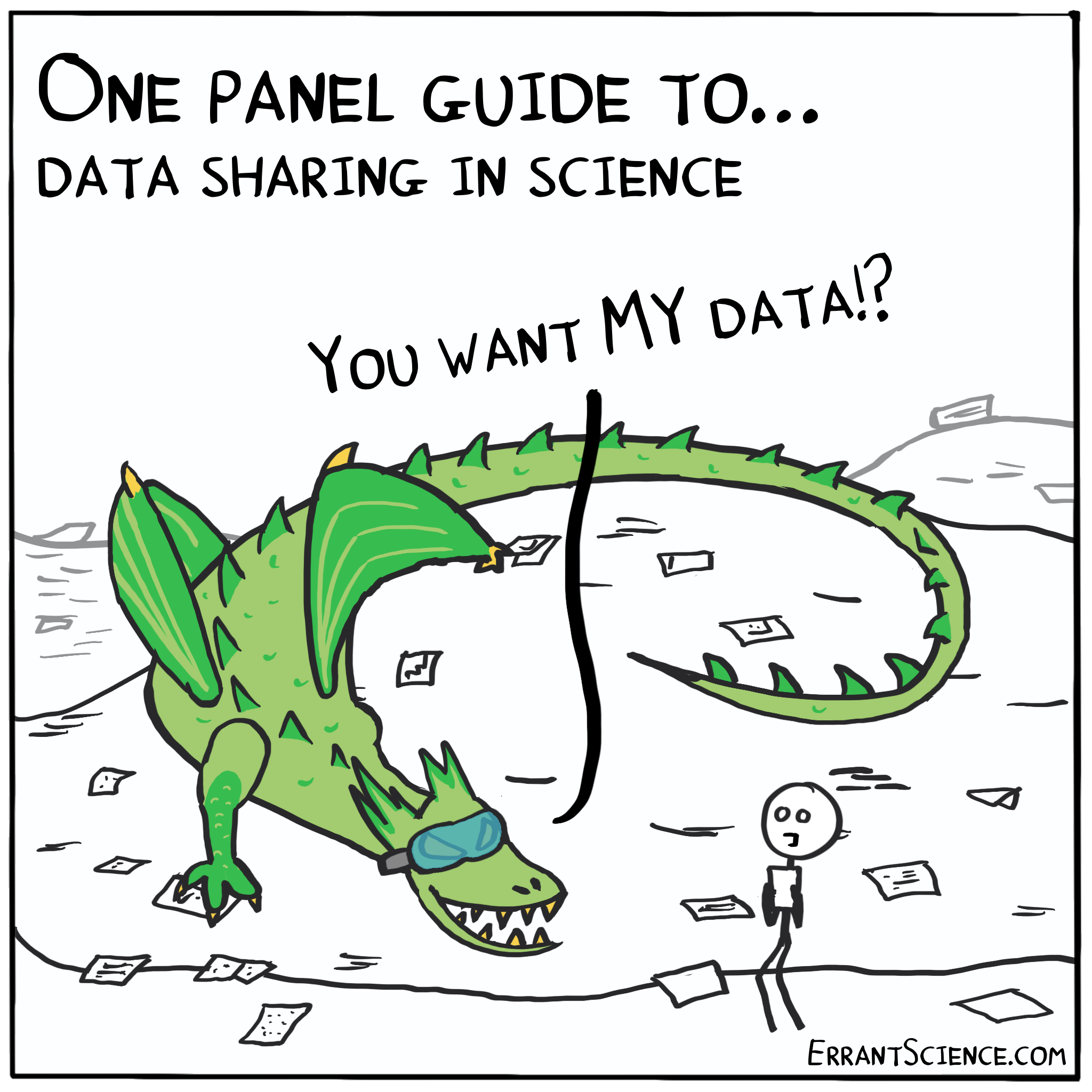
Before we discuss the benefits of data sharing it is important to recognise that this is a straightforward process. The reality of the research environment is one where the researchers compete for limited funding grants and therefore the thought of data sharing may, understandably, cause some apprehension.
There are a number of other barriers to data sharing too. They include
- Cost - Having the finances in place to pay for open access publications and the deposition of data in digital repositories.
- Lack of Time - Having enough time to properly organise and deposit your research data.
- Organising data is challenging - Dealing with large datasets can be challenging to facilitate its preservation and reuse (more later on).
- Digital literacy - Having sufficient digital skills to properly manage and archive your research data.
- Uncertainty about copyright, licensing and data protection - It is difficult to navigate the multitude of issues that need to be overcome when sharing your data.
- Repository choice - Being unsure which digital repository is the best one to choose for your data (more on this later).
- Cultural challenges - Some (sub)disciplines are more accepting of data sharing than others.
- Trust - Ensuring that the organisations and institutions that will help you share your data are trustworthy.
This whitepaper, listed below, reports on one of the largest surveys of researchers about research data (with over 7,700 respondents) and discusses the challenges that researchers face in sharing their data.
Stuart, D. et al (2018). Whitepaper: Practical challenges for researchers in data sharing. Figshare. Journal contribution. DOI: https://doi.org/10.6084/m9.figshare.5975011.v1
Why share your data? The carrot and the stick
Now, in an effort to convince you to consider sharing your research data, let’s consider the reasons why it is an important facet of your research. This can be broken down into the two following categories; which we nickname the ‘Carrot’ and the ‘Stick’.
- The tangible benefits from sharing data from your research (the carrot)
- The negative consequences that will come with not sharing your data (the stick)
Let’s start with the negatives first, the Stick
Requirement for research funding applications - As mentioned earlier we are increasingly seeing that funding agencies are requiring recipients to share research outputs as part of their grant requirements.
REF requirement - REF Guidance (for 2021 at least) requires that researchers deposit a copy of their research outputs within their institutional repository (or similar) for it to be counted within the REF submission.
Professional standards - Some discipline specific professional organisations are also encouraging the sharing of data as part of their research. An example is the Chartered Institute of Archaeologists (CIfA).
Ethical considerations - This is the notion that publicly funded research, funded at least in part through taxation and investment, should be publicly available to all.
Now let’s consider the positives, The Carrot
Visibility of your research - A more open, findable and accessible dataset will be visible to a much wider audience than those outputs found purely in traditional scholarly publications and outlets, increasing the impact of your research.
Encourages collaboration - By ensuring that your resources are more widely available, you are encouraging other researchers to collaborate with you. Open access ensures others are able to observe, use and hopefully build on your research data.
Supports integrity & replicability - By asking researchers to share our data, it forces them to start thinking about how that data is viewed by other researchers and whether your results can be replicated.
Research can advance quicker - With the data easily available to others, research that builds on earlier results can be undertaken more easily and at a much faster pace.
Improves digital literacy - To properly and efficiently manage and share our data, researchers will need to learn new digital skills. These skills will not only allow us to share our data but also improve the quality of our research overall.
Boosts citations - Research has shown that outputs available as open access resources are cited more often. This is what is often referred to as the Open Access Citation Advantage. Advantages are different for different disciplines but in most cases provide a higher citation rate and equally receive a more diverse range of citations from other disciplines and countries. More information can be found in the two papers listed below:
Tennant J.P. et al. 2016. The academic, economic and societal impacts of Open Access: an evidence-based review. F1000Research, 5:632 DOI: https://doi.org/10.12688/f1000research.8460.3
Huang, CK., Neylon, C., Montgomery, L. et al. Open access research outputs receive more diverse citations. Scientometrics 129, 825–845 (2024). DOI: https://doi.org/10.1007/s11192-023-04894-0
Wider impact (e.g. media, policy) - If you want your research to have a greater impact, either in the media or as part of governmental policy, then open access resources will be more widely shared and used in this spheres. Did you know that UK government departments do not have subscriptions to paywall journals?
This paper below, written by Biology researchers in the open access publication eLife, provides further details on the benefits of open scholarship practices for researchers.
McKiernan, E.C. et al (2016) Point of View: How open science helps researchers succeed eLife 5:e16800 DOI: https://doi.org/10.7554/eLife.16800